Showing posts with label review. Show all posts

Wednesday, November 29, 2006

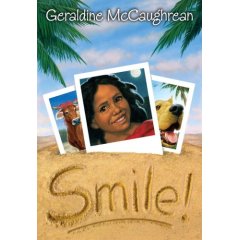
Review: Smile


This capsule review was written by Alice Herold.


Smile! by Geradine McCaughrean encourages the reader to have a fresh look at the power of photographs. Children for example, can be forever young. A photograph stops time! The photographer in the story, aptly named Flash, is a magician, a maker of pictures.

Flash's plane crashes into the wilderness. He is clutching a cheap, instant camera and has ten pictures left. Read this book to discover what he photographs and why and how the camera helps his rescuers to find him.

Many questions remained unasnswered, adding to the suspense. Was there a remote village? Was there a girl named Sutira? Did the instant camera exist? What would you photograph if you had 10 pictures only? This is a clever, thought-provoking book to be enjoyed by all ages!

Saturday, November 25, 2006

Review: Kiki Strike


This is the first in a series of reviews I'll be posting of books nominated for The Cybils in the Middle Grade Fiction category. I'm a member of the nominating committee and have thirty five books left (of 63 nominated titles) to read during the next few weeks.

I picked up Kiki Strike: Inside the Shadow City first, because so many other bloggers have loved it and now I know why. This book rocks! In fact, Kiki Strike is a book you can safely give to any girl ages nine and up. (Boys may enjoy Kiki Strike as well, but it's very much a girl power book, with nary a positive boy character in sight.)

Kiki Strike is written from Ananka Fishbein's point of view and begins when Ananka, at the time only twelve years old, spies an unusual sinkhole from the window of her Manhattan apartment. No one else is awake, so she leaves her home to take a closer look. On one side of the hole, just below the street's surface, is a perfectly preserved room. Before morning, the sinkhole is gone.

But Ananka had seen it and sets about investigating the Shadow City, a city built beneath the streets of New York. Fortunately for Ananka, her parents are perpetual PhD students and, as such, have a huge library devoted to a variety of arcane subjects. Before long, Ananka is exploring New York City with a copy of Glimpses of Gotham in her hands. She's soon noticed, at school, by a mysterious girl with white hair. Kiki Strike. Suddenly Ananka sees Kiki everywhere.

When Ananka is accused by the school bully, Princess Sidonia (of Pokrovia)* of stealing a diamond ring, Kiki comes to her rescue. And, invites her to (of all things) a girl scout meeting. Kiki has gathered a group of tween girls together, each with a special talent, in order to explore the Shadow City. There's Oona (hacker/forger/genius), Luz (engineer extraordinaire), DeeDee (chemist and explosives expert), Betty (fashion designer and master of disguise), Ananka (who doesn't know why she's there), and, of course, Kiki herself, who's a master spy and kung fu artist. The girls call themselves The Irregulars and hit the tunnels beneath NYC.

Many exciting things happen after the girls begin exploring the tunnels. There's an explosion, Kiki disappears, only to reappear a few years later when a mystery heats up. Kiki Strike is a plot-heavy book in a good way: it's always interesting and keeps you guessing. I didn't know what would happen until the very end. Kirsten Miller's characterization skills are especially adept: each girl has a strong, recognizable character; we don't know Kiki's motives or, indeed, whether she's "good" or "bad" until the final chapter; and Ananka is a hard-headed, reliable narrator with whom the reader empathizes from the first page. Here's what Ananka has to say, for example, about being a girl:
  • "I've always found that one of the biggest benefits of being a girl is that most people refuse to take you seriously. While boys must be constantly monitored and are always the first suspects when anything goes wrong, everyone expects girls to do what they're told. It may seem a little insulting at first, but low expectations can be a blessing in disguise. If you're smart, you can use people's foolishness to your own advantage. It's amazing what you can get away with when no one bothers watching."

Kiki Strike is highly, highly recommended for readers ages nine to ninety nine. It's the perfect book for a long trip or a snowy afternoon. And, Kiki Strike: Inside the Shadow City is Kirsten Miller's first novel. Here's hoping we'll see more of Kiki and friends in the future.

----------------------------------------

* The fall of the Soviet Union has been a boon for Young Adult authors. Need a kingdom? Look no further! Everyone from Pokrovia speaks Russian in Kiki Strike.
Monday, November 13, 2006

Review: The Boy Book


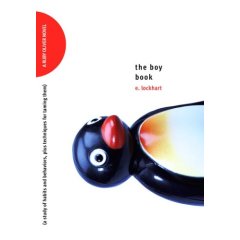
E. Lockhart's The Boy Book: A Study of Habits and Behaviors, Plus Techniques for Taming Them) is fun, fun, fun.

Ruby Oliver starts her junior year in disgrace. Once one of a foursome of girls, kissing the boyfriend of the alpha member of the group cost her her friends. It doesn't matter that the boyfriend was formerly Ruby's own boyfriend--the girls had a code and wrote it down in their "Boy Book," a collection of lists and instructions on how to deal with the male species.

Ruby's also seeing a shrink, after experiencing a series of panic attacks following her very public fall from grace. Ruby's delightfully hippie parents suspect she may be a lesbian. And, Ruby is still pining after the boy (Jackson) who caused the angst in the first place.

Lockhart has really captured the voice of your intelligent, insecure sixteen year old. Ruby is fabulous narrator, fond of lists and a footnote or two. She talks too much, is a bit of a busybody, and doesn't, frankly, understand her own motivations. At least at the beginning of the book. By the end, however, and with the help of Dr. Z, new friends, old friends, and, yes, even her parents, Ruby has grown up enough to give the "Boy Book" away:

Nancy Drews
That is, things I am good at*
1. The backstroke. Not great, but decent and getting better.
2. Talking. I'm like my mom that way.
3. Making lists. I really could medal in this one.
4. Movies. Remembering trivia and being able to say semi-intelligent stuff about cinema when called upon to do so.
5. Getting animals to like me. And not being afraid of them.
...
----------------------------------
* A homework assignment from Doctor Z, which she shrinkily calls a list of affirmations, but which I prefer to term Nancy Drews, because Nancy Drew, girl detective, was good at everything, even horseback riding and water ballet, though there was no evidence she had ever practiced or even heard of either one until she miraculously turned out to be expert at them.

Hah! That's just what I thought of Nancy Drew.

Ruby Oliver finds some of herself over the course of The Boy Book and more. She learns how to be a better friend, that there's always two sides to the story, and that being yourself isn't such a bad thing.

The Boy Book is highly recommended for teens ages 14 and up. It's funny, sweet, and so very true.

Friday, November 10, 2006

Poetry Friday Review: Ninety-Three in Our Family


Do you know a child who likes a tall tale? Or a child who loves animals and is constantly begging for just one more pet? Then Ninety-Three in My Family is for you!

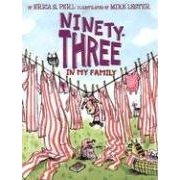
Ninety-Three in My Family, written by Erica S. Perl and illustrated by Mike Lester, begins in the classroom. Today's topic? Our Families. The unflappable teacher asks the young narrator, "'How many live with you?'" And he answers, "I counted quickly in my head. I told her, 'Ninety-two.'"

Why ninety-two? Well here's the narrator's rundown as this week's Poetry Friday entry:

There's twenty-seven owls,
Ten cats, eleven dogs,
A pygmy hippo named Bernice,
And eight blue speckled frogs.

My mommy and my daddy,
My sister's gerbil, Ed,
Six goldfish and my sisters,
Darlene and Winifred.

Whenever people ask me
How many live with me,
I tell them true, there's ninety-two.
Plus one (that's me!), we're ninety-three.

Told in lively verse, Ninety-Three in My Family makes for a truly fun read-aloud. Mike Lester's illustrations are dynamic and, needless to say, packed with animals. The owls, with their grumpy faces, are particularly (dare I say it?) cute. Each colorful page has plenty to look at and look for. The book concludes with a surprise certain to delight the young reader.

Ninety-Three in My Family is highly recommended fun for children ages three-ten.

-------------------------------------------
Nancy at Journey Woman will be doing this week's Poetry Friday roundup. Head on over and leave her a comment.

Thursday, November 09, 2006

Review: Shelter


I had a lot to do this morning. I'm preparing for a conference, writing an abstract for another conference, working with e-mail accounts, scheming for the next two The Edge of the Forests, organizing Cybils lists, etc. It was not the morning to pick up Shelter, by Beth Cooley. Shelter is an unputdownable novel. Two hours later and here I am with a review.

Lucy Durbin had it all, even if she didn't know it. She lived in a comfortable home, attended a swanky school, shopped for fun with her wealthy friends, and took ballet lessons. She had the life of your typical privileged American teen.

Lucy's life changes virtually overnight. Her father dies in a car accident and her stay-at-home mom discovers their financial stability was only a mirage. There's a mountain of debt, no life insurance, and a huge mortgage. Soon Lucy, her mother, and five-year-old Jimmy are on a quick downward spiral which ends at St. Agatha's shelter.

Lucy tries to resent her mother, but it's impossible. Cindy Durbin is more lost than her daughter is. She has no education, has never worked a day in her life, is used to a comfortable lifestyle, and worries especially about little Jimmy, who is small for his age and has been very coddled as the youngest child.

Living at St. Agatha's are women and children down on their luck. There's a high school dropout with a young child and a woman whose boyfriend was arrested for a meth lab in her basement. A Romanian mail order bride arrives after climbing out her bathroom window.

Lucy is a wonderful character with a compelling voice. As the eldest child, one who has to help her mother more than she should, she's hardworking and determined to make it. Here's what she thinks after her sixteenth birthday celebration in the shelter:
  • "I lay awake for a long time thinking about the day. Being sixteen really meant something. It meant more than just being able to drive or get a job. It meant taking charge of your life. Or screwing it up. At sixteen Crystal was pregnant, Jan was dealing, Tina was on the streets. I might be in a shelter, but I wasn't messed up. I could make things happen. Good things."

Lucy does make good things happen--for herself and for her mother. Jimmy actually thrives in his new environment, allowed to grow up for the first time in his life.

Shelter is technically a Young Adult novel, but the content is tame enough for readers as young as eleven. It's a beautifully written novel with a very important message. But, don't get me wrong, Shelter is not a preachy novel in any way. It shows, rather than tells, that anyone is just a step away from bad luck and the collapse of their comfortable life. What you make of that luck is what matters. Lucy accepts help, finds friends and compassion in places she least expected it, and discovers herself in return.

Shelter will be released on November 14.

ETA: Isn't this a great cover? It really draws you in and it fits the book perfectly.

Wednesday, November 08, 2006

Review: Toys Go Out


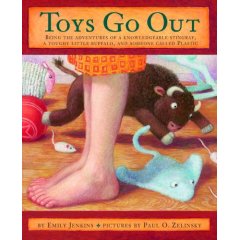
Toys Go Out, by Emily Jenkins and illustrated by Paul O. Zelinsky, is one of those increasingly rare books--Middle Grade fiction aimed at the younger reader. Perfect for the six-to ten-year-old audience (and even younger, if read aloud), Toys Go Out: Being the Adventures of a Knowledgeable Stingray, a Toughy Little Buffalo, and Someone Called Plastic tells what happens amongst the toys when no one is watching.

As the subtitle indicates, the movers and shakers in Little Girl's world are a stingray, a buffalo, and "someone called plastic." The first episode, "In the Backpack, Where it is Very Dark," finds the three friends (and rivals for Little Girl's affections) bouncing along in a backpack. They're afraid: Will they be thrown away? Are they going on a scary trip? Why does it smell so badly in the backpack? Fortunately they're the starring attraction at Show-and-Tell, their status as Little Girl's favorites confirmed.

Over the course of Toys Go Out, Stingray, Buffalo, and Plastic discover who they are and why each of them has a specific role in Little Girl's life. Stingray sleeps with Little Girl, Buffalo is a loved toy, and Plastic....Well, I'll let you discover who plastic is yourself.

Plastic, Buffalo, and Stingray are marvelous characters, but there's a fabulous supporting cast in Toys Go Out as well. Sheep is perhaps my favorite. When Buffalo hides because he's covered in peanut butter and does not want to go into the washing machine, he hides in a soccer shoe in the closet. Sheep wanders in and the following episode transpires:

"Sheep doesn't understand. She is distracted by the tasty-looking lace of the soccer shoe. It's not grass, and it's not clover, but it looks pretty chewable to the sheep.

She settles down next to the shoe and has herself a lovely munch, pulling the lace out bit by bit. She hears a Wurrffle Wummmpffle noise, and it's irritating, but she doesn't let it bother her. Pretty soon the sound quiets down to nothing.

When she is done chewing the lace, Sheep is mildly surprised to find herself in the closet. She burps and goes out to play pick-up sticks with the toy mice."

Buffalo is responsible for the Wurrffle Wummmpffle, being trapped in the shoe. Sheep, as you have read, had other concerns. The toys also interact with an urbane, intelligent, yellow towel named Tuk-Tuk and a grumpy, lonely washing machine.

Toys Go Out is highly recommended for children ages five to ten. It's funny, charming, and Zelinsky's drawings are a treat.

Toys Go Out has been nominated for The Cybils in the Middle Grade Fiction category.

Thursday, November 02, 2006

Review: Carrot Soup

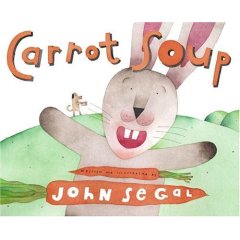
The hero of John Segal's Carrot Soup is obsessed with his garden. In particular, he's obsessed with his carrot crop.

Carrot Soup begins in the spring, "Rabbit's favorite season," when Rabbit orders seeds and begins planting. He orders Early Horn, Lunar White, Short 'n' Sweet, Bolero, Thumbelina, Sugarsnax, Paris Market and Autumn King carrots. And to think I thought carrots came in "regular" and "mini" sizes! Children will love Segal's illustrations of the different carrots in all their glory.

Rabbit plants his carrots, takes care of them in the proper way by weeding and plowing and watering. Oh, and waiting. And waiting and waiting and waiting.

When it's time to harvest and make carrot soup, the carrots have disappeared. Rabbit is highly distressed. He darts about asking all the animals in the neighborhood if they've seen his carrots. All's well that ends well, though, and Segal concludes his story with a great recipe for carrot soup.

Carrot Soup is an enchanting tale about friendship and hard work--perfect for a garden-themed read aloud. Segal's illustrations are infectious fun and the soup recipe a treat. Enjoy!